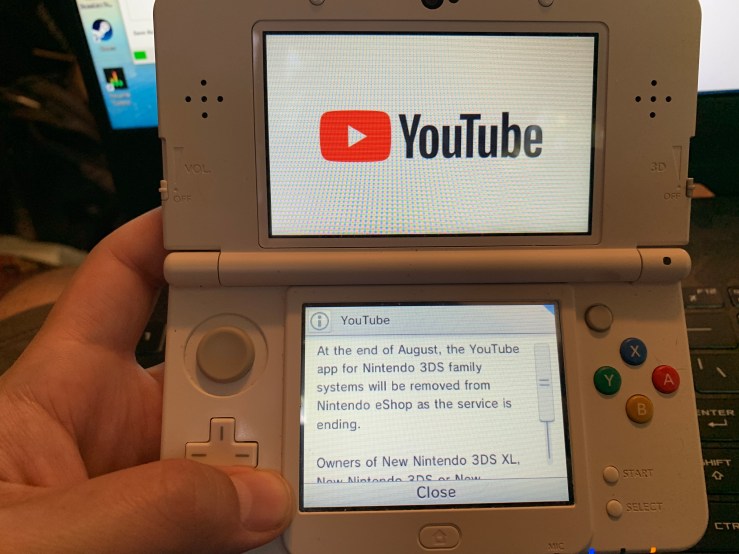
I got a notification on my 3DS the other day, something that has become a rare occurrence. I was always into the StreetPass stuff and I got excited for a second. Just a second. The notification came from YouTube announcing the company would be discontinuing support for the YouTube app on the Nintendo handheld.
I just noticed it says “At the end of August…” and it’s September.
This shouldn’t come as a surprise to anyone. It seems everyone with a voice on the internet has declared the death of the final iteration of the 3DS family. Nintendo hasn’t made such a definitive announcement but with no upcoming releases for the system and the Switch Lite launching on 9/20, it doesn’t take much detective work to put the pieces together.
That doesn’t mean I have to be happy about it. Look, I expected this. It happens with every console and like other consoles I’m not going to stop playing or collecting for this one. The 3DS was special, though. My affinity for handhelds aside, the 3DS (and especially the New 3DS) is an impressive piece of hardware. The home screen alone made this feel like a real console. There were apps for Netflix and YouTube, mini-games that utilized the stereoscopic 3D functionality, and it even looked good. I loved each and every Nintendo handheld leading up to the launch of the 3DS in 2011 but it felt like they were treating it as a console, not just a handheld.
Early sales were rocky but it was an expensive unit. Nintendo dropped the price from $249 to $169 and tossed 10 NES and 10 Game Boy titles via the eShop to anyone who had purchased their system at the original price. That seemed to do the trick, leading to over 70-million units sold over its lifespan. Compare that to the Wii U’s 13-million units sold from 2012 to 2017, it’s clear that the 3DS was doing a lot of the work for a good chunk of time.
I didn’t mean to go on eulogizing like this. I was kind of put off by a lot of seemingly gleeful articles and videos about the end of the 3DS. It’s not that I’m all, “no, the 3DS will never die! Arrrrrrg!” But I am for more quiet reflection of a system that was, and still is, very important to me, as well as to the history of Nintendo. By our nature, people who are into retro games aren’t quick to toss aside outdated hardware because the next generation has a better frame rate or a more powerful processor. One of the many things I find so compelling about Nintendo is their ambition to carve out their own path in a crowded market. While other companies vie for the title of fastest or most powerful, Nintendo challenges itself to be the most fun if not the most interesting. That does a lot for a system’s longevity.
Gunpei Yokoi implemented his “lateral thinking” philosophy with the Game Boy; instead of using state of the art technology, he opted to innovate using “mature” tech which would be well tested and cheaper to produce. Today, Nintendo isn’t the place I go in search of the most impressive graphics. I expect to find excellent game design and hardware that delivers experiences well. The 3DS frequently met those expectations and occasionally exceeded them. Tentpole titles like Animal Crossing: New Leaf, Pokemon: Sun/Moon, Fire Emblem: Awakening, and many more were as exciting as any home console release and I could take them with me anywhere.
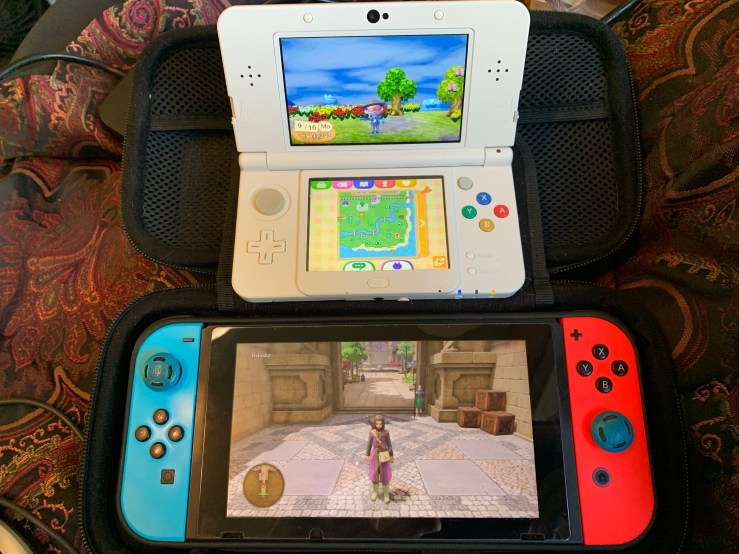
The Switch is an impressive successor, if you can call it that. I’m still not sure. I love my Switch and it goes with me on road trips, but it’s not quite the same. It doesn’t fit in my pocket like the 3DS (I have a smaller New 3DS – unless I dig out my Jnco’s, there’s no way I can accommodate an XL) and size makes a big difference. I’m interested to check out the Switch Lite but I don’t think there’s a lot of incentive for me to go that route. Not yet anyway.
It’s a good little family.
This little system has a lot of life left. There are still so many games for the 3DS (and the DS for that matter) that I have yet to play. Let me know some of your favorite games!
Imagine a new Star Wars video game that looks nothing like Battlefront. Quite the opposite. Imagine cute, 16-bit sprites of your favorite heroes from a long time ago. Imagine a top-down action RPG that takes place between The Empire Strikes Back and Return of the Jedi, but it has nothing to do with whatever was going on in Shadows of the Empire. Imagine a story-rich adventure that takes place during Luke Skywalker’s training on Dagobah with Jedi Master Yoda.
Imagine the game isn’t really about Luke, but rather, as the name would imply, focuses on Yoda. Think of the Luke segments as tutorials where Yoda introduces new powers or techniques to young Skywalker (and the player) and the real game takes place in the past. Yoda shares stories of his adventures with his Padawan and how he overcame obstacles similar to those which Luke must soon face in an exciting, expansive role playing game, rich with action and exploration, harkening back to 2D Zelda games.
Imagine all you want. I did, and that’s not at all what Yoda Stories is.
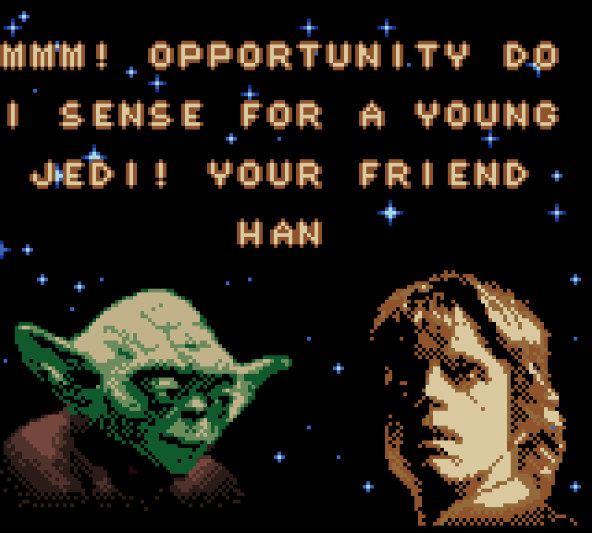
Because Yoda was always super cool with Luke taking a break from his training for whatever.
I first discovered Star Wars: Yoda Stories in a video game magazine. I imagine it was GamePro because that’s the one I was subscribed to, but despite all my digging I couldn’t find an article or advertisement. I didn’t have a lot of money for games growing up, so it’s not like I could have rushed out and bought it. But I remembered it. Time, however, didn’t seem to reserve much memory for the game as I did. After a while, I thought I had simply imagined it. But the visuals were so clear in my head; it looked like Earthbound or Legend of Zelda: A Link To The Past but Star Wars. It became a mysterious thing, and where I couldn’t know what it was, I could imagine what it could be.
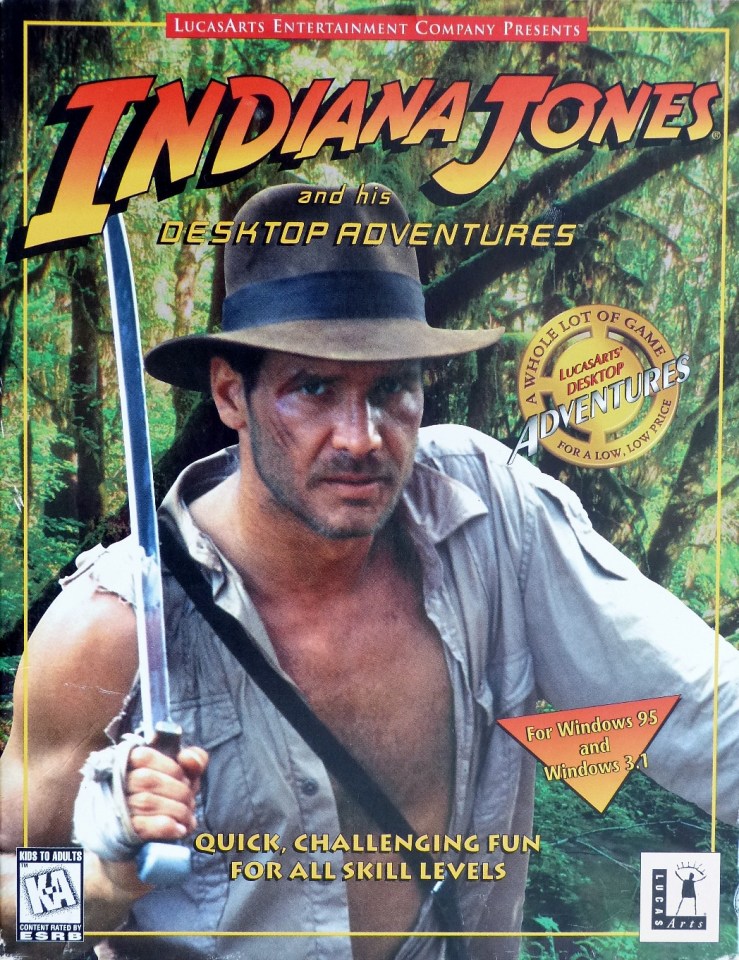
Before Yoda Stories, LucasArts released Indiana Jones and his Desktop Adventures. What a title. LucasArts had a very good reputation as a game developer, particularly for adventure games like Monkey Island, Day of the Tentacle, and Dig. (I don’t know how well Dig specifically was received, but I loved it.) Released for Windows and Mac in 1996, Desktop Adventures takes place in 1930s Mexico, where Indy must overcome thieves and spiders and jaguars (oh my) in order to protect valuable treasures and artifacts. The player navigates procedurally-generated levels using a keyboard or mouse, collecting items while fending off enemies. The colorful, top-down adventure game was, according to reviews, shallow but addictive. That, apparently, was kind of the point. Desktop Adventures was unlike the games they were most well known for, instead serving as a time-filler, something to occupy the same space as a solitaire or Minesweeper. Kotaku’s Luke Plunkett wrote in 2011, “The games had the right idea, then. They just came out too early … if these games came out on something like Facebook (and were improved just a little) they’d be massive hits.”
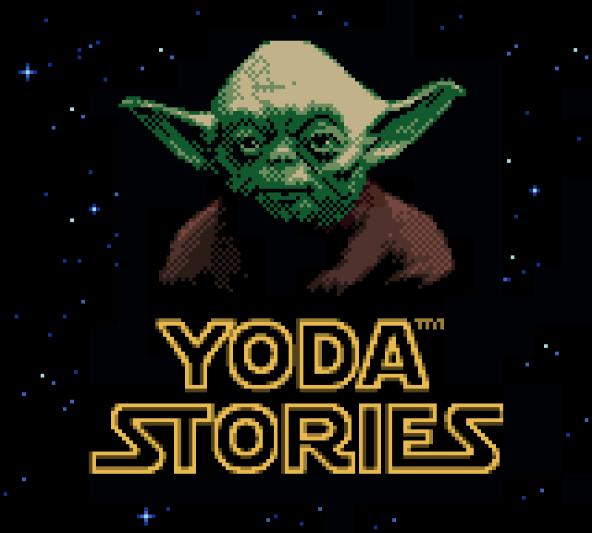
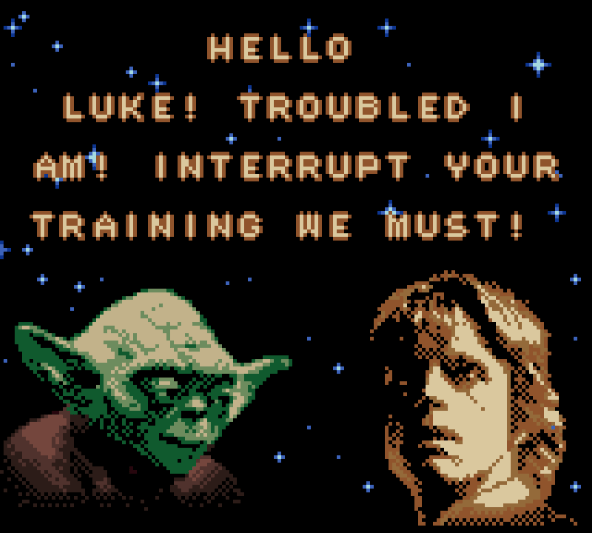
In 1997, LucasArts brought us Star Wars: Yoda Stories, the second (and final) entry in the Desktop Adventures series. The game plays just like its predecessor: explore randomly generated maps while fighting off enemies to collect items to trade for other items until you finally acquire the item you need to clear the stage. The game was not received terribly well but it did manage to get a port on the Game Boy Color in 1999. I found a copy last year and decided to play it. I knew it would be bad and that it wouldn’t bear any resemblance to what I had imagined years ago. But I was ready. And in terms of badness, Yoda Stories does not disappoint.
I was born here, ya know.
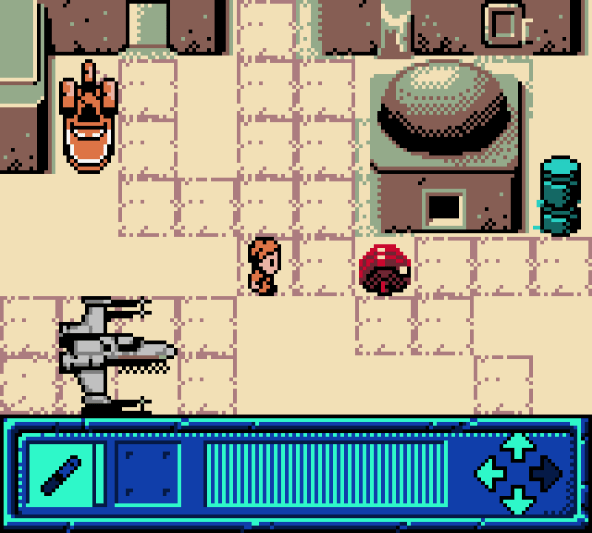
The Game Boy Color port looks very similar to screenshots I’d seen of its PC counterpart, but with the quality knob turned way down. It was developed by Torus and published by THQ. The GBC obviously has its limitations but I’ve been thoroughly impressed with what it’s capable of in the right hands. Such care was not taken with this one, but for a game that is backwards compatible with the classic DMG, I suppose it doesn’t look all that bad.
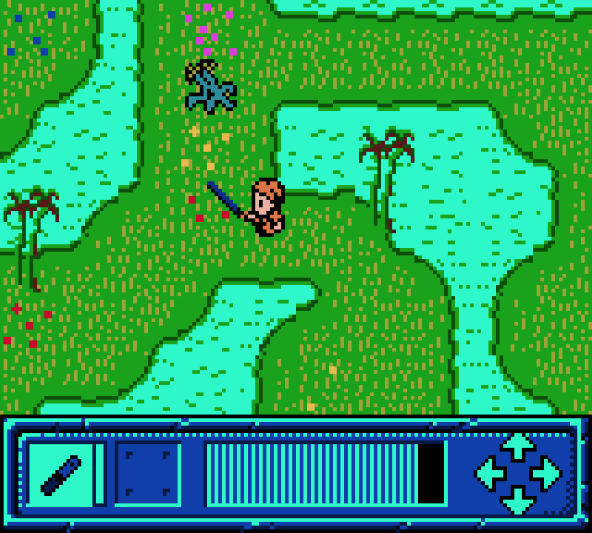
Looks aside, this game doesn’t feel good. Moving Luke around the map is jarring. It feels less like movement than rapidly teleporting from one square to the next and the screen follows in a similarly jerky manner. Pressing the D-Pad points Luke in a direction, while holding or pressing that direction again will move him. This can be useful when examining items but it’s dreadful when maneuvering around enemies. I found myself wildly mashing the A button to swing my lightsaber … swing is a strong word, it’s more of a wiggle. I would wiggle wildly at a snake as it flashed around me. It’s like fighting under an 8-bit strobe light. Oh, and if you’re into hearing the Star Wars Theme over and over again, this game is for you! 15 stages, 1 song.
How about a Saber-Blue Gatorade?
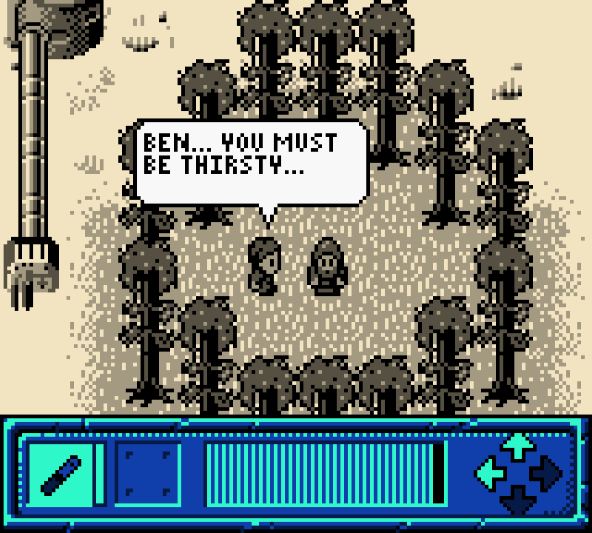
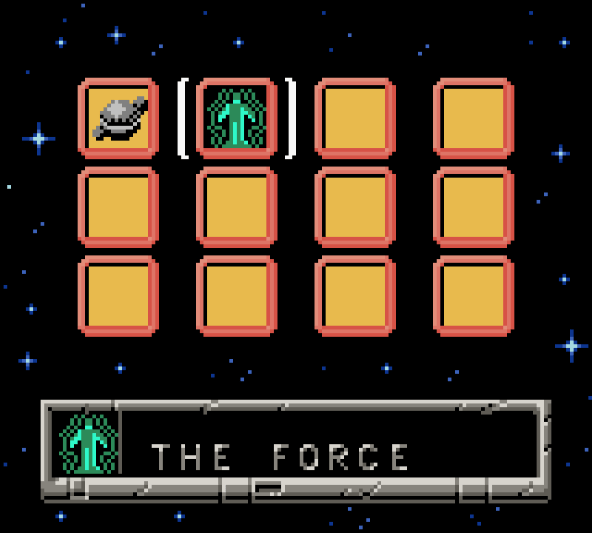
The first stage begins with Yoda sending Luke to rescue the Millennium Falcon from the clutches of the Empire. You get your first item, a power coupling, and you’re off to Tatooine. The first time I played, I accomplished nothing. I wandered around, I fought some snakes and eventually some stormtroopers, I died and I shut off the game. More recently, I decided to give it another go. I discovered that I could move certain objects by holding the B button and moving around. This revelation meant I could access new areas. I was finding items like blasters, med kits, and keycards to unlock doors. I found Obi Wan Kenobi who gave me the Force. (It’s an item you equip.)
THE FORCE
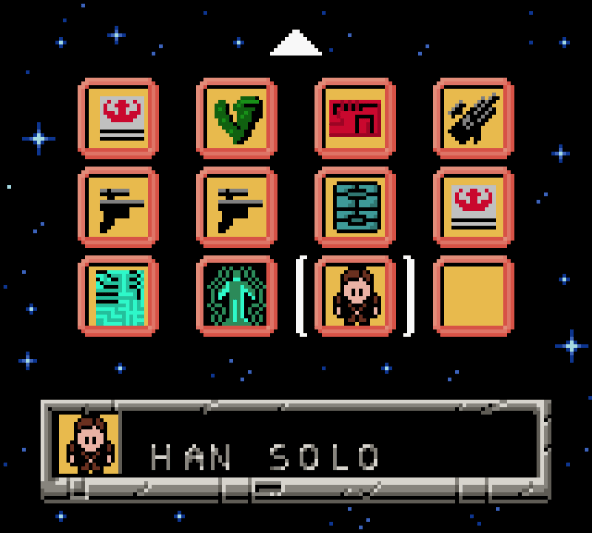
I was darting around the planet, collecting key items to trade to various NPCs for other key items to trade for other key items to trade for Han Solo – wait, Han Solo is an item?
It’s a one of a kind.
I brought Han Solo to the secret base where the Millennium Falcon was hidden and while the smuggler extraordinaire fired up the old hunk of junk, I fought off wave after wave of stormtroopers. I was feeling the rhythm of the strobing pixels, dodging oncoming attacks, alternating blasters and my lightsaber until the final Imperial soldier had fallen. The Falcon took off and I had completed my mission. And I had … fun? Yeah, I actually had fun. Once I had a handle on the clunky controls and figured out that there were objectives, I started sort-of enjoying this stupid game.
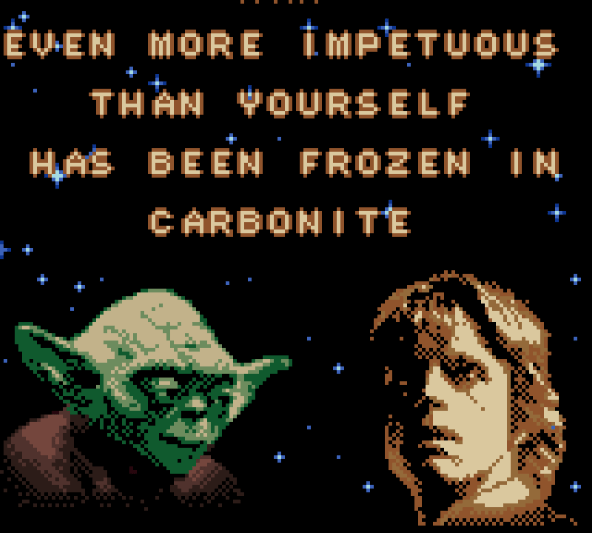
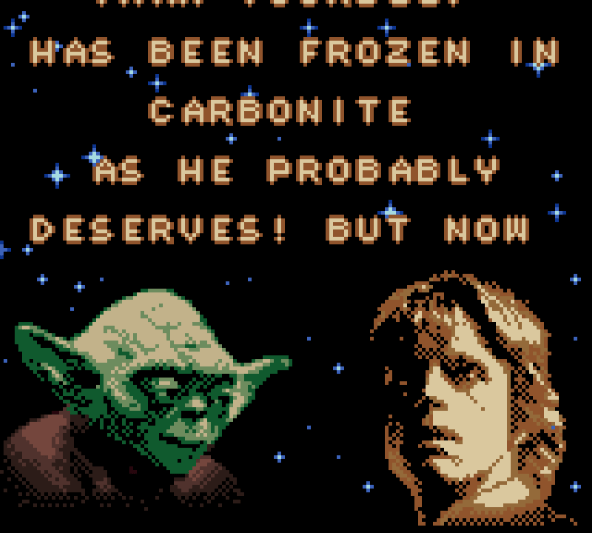
Wait, did Luke just pay off Han’s debt? And if this takes place between Empire and Jedi, (or even during Empire, which would explain why Luke still has his father’s blue lightsaber) why does Greedo have Han in this bar? And how did he end up back in carbonite in Jabba’s palace at the start of Jedi. It’s like this game doesn’t care about continuity!
Unlike the version for Windows, the maps in Yoda Stories for GBC are not randomly generated. There are 15 unique stages and a password system to pick up where you left off. I haven’t managed to finish all 15. I may never. Just like I may never know why this game was made. It barely has a place in the Star Wars (Legends) canon. It’s a very simple game but manages to be too clunky to say it’s easy enough for casual gamers. It was not especially well liked when it was initially released but managed to get a port over two years later.
Wiggle that saber at mushroom spiders!
It’s not even all that fun to hate on. I just kind of feel sad that it’s not a good game, and that it wasn’t really designed to be a good game. I won’t dwell on it though. I’ll just go and make my own game and if I need to kill a little time, I’ll pop in Dr. Mario. And if I find I’m a little burnt out on Dr. Mario, I’ll play some Tetris. But if I need a good time killer with a little more action, there’s always Solar Striker. And if I crash and burn one too many times in Solar Striker, I’ll always be able to consider playing Star Wars: Yoda Stories.
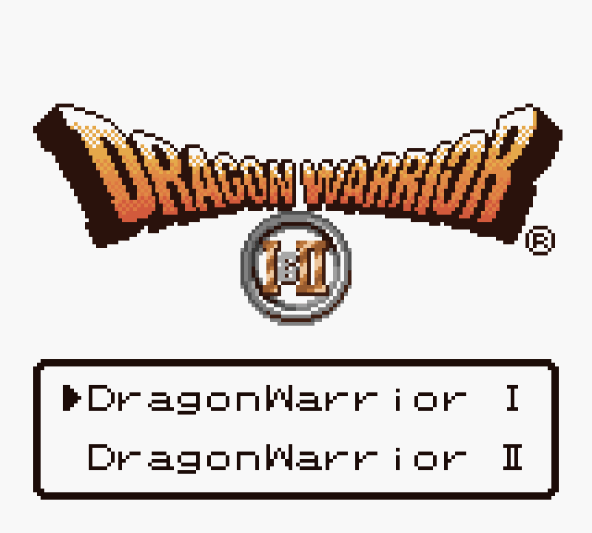
Two games in one cartridge. How could you go wrong? If you’re into classic JRPGs, you can’t go wrong here. I played through Dragon Warrior I for the Game Boy Color and I have thoughts about it.
Starting this game felt a lot like the first time I played Dragon Warrior on the NES. I was in middle school and my friend and I were digging through a load of cartridges we acquired… somewhere. Like you do. In the late 90’s, NES games just seemed to appear in your basement. It’s as though some old Wizard was unloading whatever he couldn’t move at his last yard sale through random portals. Kids like me who didn’t have any console during its heyday were happy to be the dumping ground for wizard garbage.
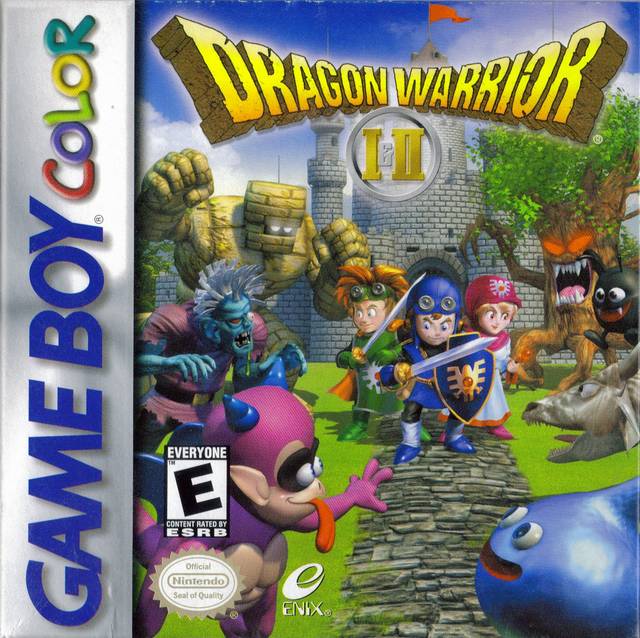
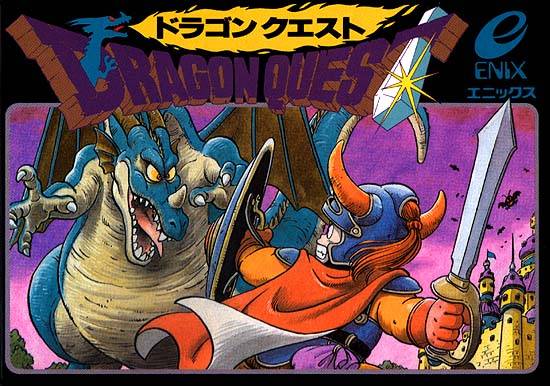
Look at that. Who wouldn’t want to play that game?
I somehow had a copy of Dragon Warrior and my friend and I liked the cover art, so we popped it in. Then we proceeded to get lost and confused. We didn’t know where to go, and when we wandered too far we would get destroyed by some creature we had no business looking at, let alone engaging in turn-based combat with. Where it was just a cartridge loose in a box of games, we couldn’t consult the manual for anything we might be missing. But we were dedicated nerds and eventually figured out what we were doing.
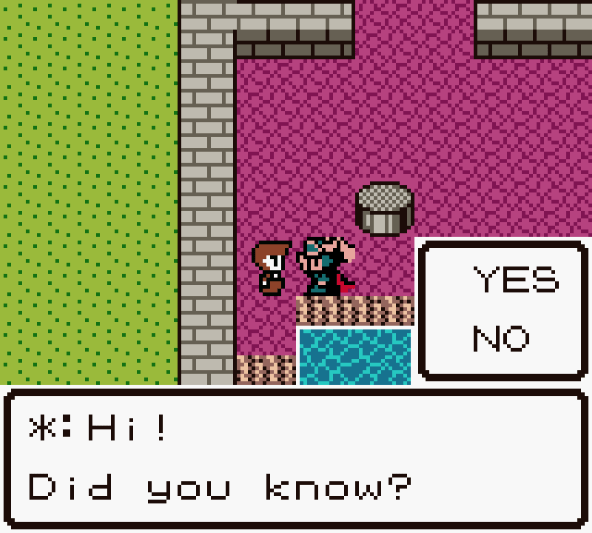
Jump ahead to now, playing Dragon Warrior for the Game Boy Color (on a Game Boy SP) and it’s like I’m still in my parents’ basement trying to figure out where I’m supposed to go. Did I miss something the king said to me at the beginning? Did his assistant (what do you call kings’ assistants?) tell me something important? Because now he’s telling me to save the king’s daughter but I don’t know where that is. I think someone told me to go north. I’ll go north.
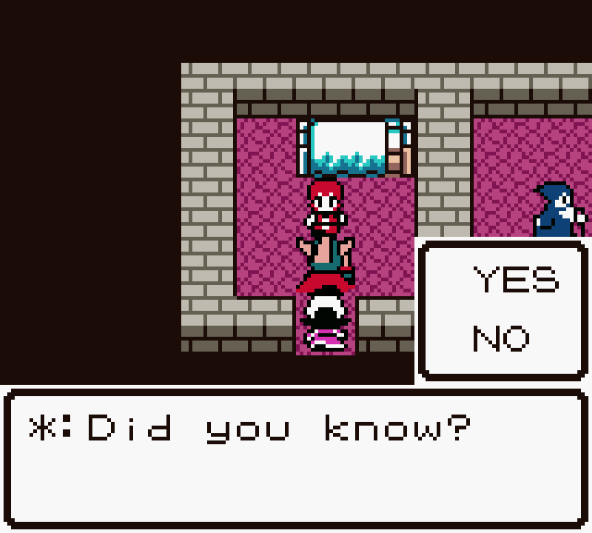
Did you know Dragon Warrior wasn’t originally called Dragon Warrior? In 1986, the game was released in Japan for the Famicom under the name Dragon Quest, a name that is probably familiar to you at this point, considering there are now 11 installments in the main series along with a bunch of spin-offs. The title was changed for the North American because Simulation Publications had already trademarked DragonQuest, for their pen-and-paper RPG. Interestingly, Simulation Publications landed on DragonQuest because their original title, Dragonslayer, had already been claimed by Disney. In 2003, Square Enix registered Dragon Quest in the US without a word from DragonQuest’s current owner Wizards of the Coast. WotC seems to be doing fine without it.
In the early days of Enix, having recently shifted from tabloid publication to video game publication, the company was looking for people to make games. Enix sponsored a game design contest, featured in computer and manga magazines. Freelance writer Yuji Horii entered with Love Tennis Match and won the contest. The game went on to become the first Enix release, and Yuji Horii began his career as a game designer.
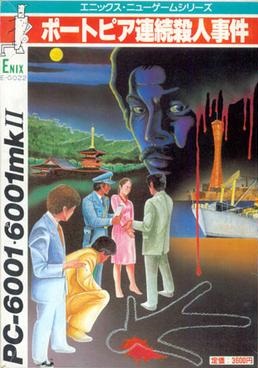
Horii’s next release was The Portopia Serial Murder Case, an adventure game for the NEC PC-6001, released by Enix in 1983. While a detective story might not sound like the natural predecessor to a fantasy RPG series, Horii would later draw much inspiration from Portopia for his 1986 game, Dragon Quest. Traversing an open world, talking to a bunch of characters to figure out where you’re supposed to go next could describe either game. Portopia saw a Famicom release which included new content such as a dungeon maze, which was a sign of things to come.
Yuji Horii was fascinated by RPGs like Wizardry and Ultima, and he wanted to create a game that would introduce Japanese gamers to the genre. He also wanted his game to be on a console as opposed to PCs where most western RPGs lived. Games like Wizardry were dense and complicated, and though Horii was into it, but he knew he could reach a wider audience with a simpler game. Making an RPG for the Famicom meant streamlining controls and increasing accessibility to more casual players.
The resulting game was well received. I mean, it would have to be, considering we’re up to Dragon Quest XI now. Despite a rocky start, the game sold over 2 million copies in Japan alone. Dragon Quest pretty much set the standard for how an RPG should look and function for a very long time. The top-down perspective when traversing the world map and towns, random enemy encounters that open up a new perspective during battle. The exploration, story, dialogue between characters: while inspired by games past, Dragon Quest packaged and polished the experience so well it became the blueprint for similar games for years to come.
Dragon Quest was also popular enough that people wanted to pay for it again. The first three installments have seen several remakes, but I’m going to focus on the Game Boy Color release. Dragon Warrior I&II released in North America on September 27, 2000. This remake was unique in that it contains a new translation of the original Japanese text. For instance, “Dragonlord” is now “DracoLord” (big difference, I know) and the mythical hero from which our protagonist descended, once “Erdrick” is now “Loto”. This release also includes updates to earned experience and gold. Rather than say it’s easier, I like to think of it as less time consuming. Don’t get me wrong, I love grinding in RPGs, but if the “challenge” of the game is smacking slimes for two hours before you can safely cross a bridge, I’ll take the easy mode. Let’s do this.
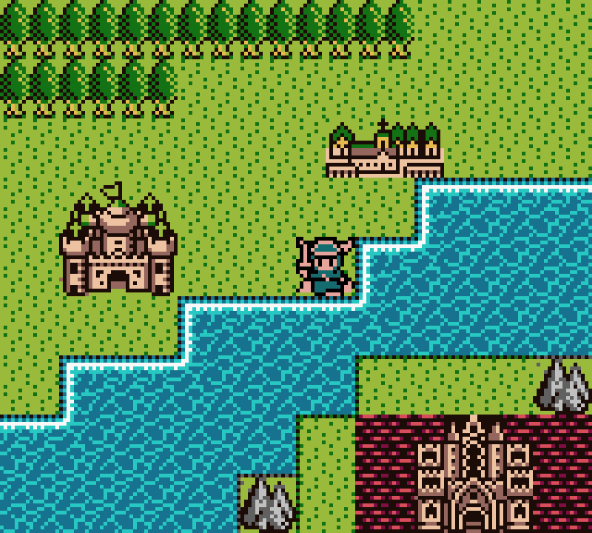
We are now in a land known as Alefgard. The game opens with a beautifully animated sequence depicting DracoLord stealing the Light Orb from Tantegel Castle, because DracoLords always steal your orbs. This particular orb, retrieved (via the gods) and donated by the brave warrior Loto, had been protecting Tantegel from monsters for many years. And to add kidnapping to theft, DracoLord also captured King Lorik’s daughter. The protagonist, whom I have dubbed Bobo, is the descendant of Loto, and Alefgard’s best hope of defeating DracoLord, rescuing the princess, and returning the Light Orb to its rightful home.
You don’t have to save the princess to beat the game!
The plot is straightforward, as far as these fantasy stories go. Bobo has to defeat DracoLord, but in order to do so, he must collect a series of magical items. And get stronger. Much stronger.
The end is in sight from the beginning. You can see the castle where DracoLord resides as soon as you step out of Tantegel Castle. In an effort to make his RPG more accessible than its predecessors, Yuji Horii plainly stated the player’s goal. Other efforts included designing the progression system so that the player would level up quickly at the beginning of the game, and slowing down gradually throughout. The fast leveling in the early game was meant to encourage the player by making their progress evident.
Bobo begins his journey like any other royally appointed adventurer: wandering (but not too far) around the world beating up monsters for money. Bobo must be the squishiest descendant of Loto ever. King Lorik was kind enough to donate 120G to our hero, enough money to buy a club and some cloth armor. The king himself sent Bobo on this very important quest and couldn’t spare enough gold for a proper sword. Or maybe a loaner that’s hanging around the castle. “The DracoLord is a terribly powerful foe, and now that he has the orb, the world as we know it is in grave danger. Here’s a stick. That’s what you warriors like, right? Sticks? With which to thwap your opponents? It’s not safe going solo, so… take this thwapper.”
There is something exciting about getting lost. I end up walking around, grinding for xp, stumbling into towns and happening my way back into the story. I don’t know if I played the game the “right way,” but I had fun with it. Stumbling around the map can lead to disaster for poor Bobo. I discovered a cave and I went in because that’s what Bobos do. In this cave was a dragon that kicked my level-9 ass. When Bobo eventually took out the dragon, he discovered Princess Lora! Bobo then carries Lora back to the castle. They even animated a sprite of Bobo carrying Lora – very interesting! Lora is pretty hard in love with Bobo. So much so that she gives him an item called “LorasLove” which allows Bobo to hear her voice, saying she loves him, how much XP to next level, and how far away he is from her. This functions as a navigation tool, X spaces East/West, X spaces North/South: important in finding the location of Lotos Seal, which is just buried out in the world somewhere.
This is not a game that holds your hand. NPCs will casually dispense information that makes little sense out of context. For instance, I managed to find the Pokeflute … I mean Pixie Flute which is supposed to put “the Golem” to sleep. Clues from various characters eventually led me to a town called Kol where the flute could be found in an unmarked spot four steps south of the bath house. You really have to talk to everyone to get anywhere. I feel like that’s a rule of RPGs that has kind of fallen out of style (and I think that’s a good thing!) Take Skyrim which has big old markers on your compass and map telling you where to go. And it has a map.
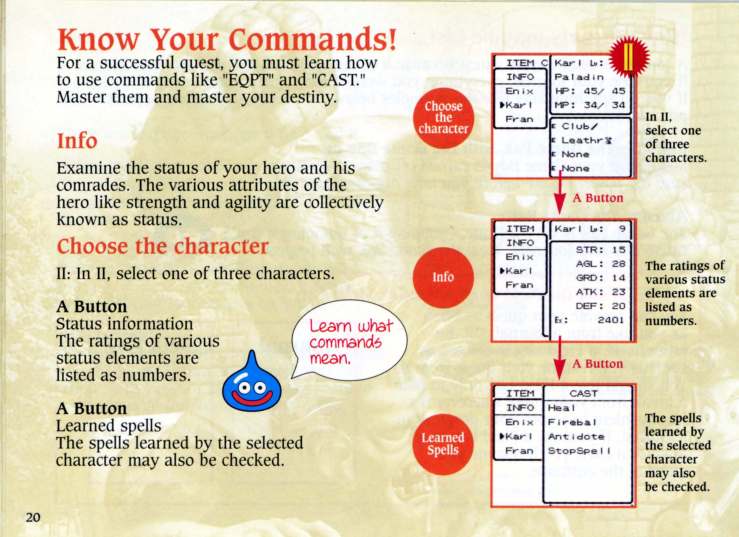
I downloaded the game manual and there is in fact a map! So when some townsperson tells you to “go to Mercado,” you’re not completely lost. It just shows you where the towns are; no indication of shrines or dungeons. Just like in real life. I ran around for quite a while looking for the shrine or cave Northwest of Kol before downloading a more comprehensive map. It’s one of those moments when I think to myself, “how could I have possibly missed this?!” And yet I’ve probably spent over an hour running back and forth between towns. So as frustrated as I got, when I did finally give in and look it up, I ultimately felt like the game wasn’t cheating me. I was just lost.
Who do you think would win in a fight: Slimon or Clippy?
When I play a lot of these older games (especially RPGs) I realize the user interface can be a big part of the challenge. In Pokemon Red/Blue it’s tough to keeping track of items, boxes, etc. I like giving my Pokemon weird or silly names. In replaying Blue after its release on Virtual Console, I started naming my pocket monsters only to be reminded that my battle pets share sprites in the menu based on type. My naming convention doesn’t narrow things down. Additionally, there is no telling if I have already caught a Pokemon I’m facing down in the field. Gotta open up the Pokedex and… remember. Like, with my real-life brain.
The game is hard and that makes it fun, however frustrating. It’s rare that I die in RPGs of late. Not because I’m an exceptionally gifted player, I just know how they work and they have gotten pretty good at showing you the correct path. If you follow the path, the challenges will be well balanced. No such luck here. At one point, some Wizard asks if I’ve been to some Shrine. I say no and he says, “Go South.” So I go south and I don’t see anything so I start wandering East and West and ultimately I get myself killed in the process. This sends you back to the castle at the beginning of the game. At this point the trek back to where I was is an easy one, as I’ve leveled accordingly, but what a pain in the ass! I suppose it’s better than losing all my progress since my last save.
Saving is a little inconvenient in this game, but it was the early days of save batteries. In the original release, Bobo would have to travel back to Tantegel Castle and talk to King Lorik, who will record your progress. This king, man, doesn’t he have better things to do than play secretary to a schlub with a club named Bobo? Thankfully, in the GBC release, one of the added features is a quicksave function. Press start wherever you are, and it will create a field log allowing you to pick up exactly where you left off. I don’t know how my friend and I did it on the NES. Knowing us, we probably just left the system on and turned off the TV.
The world of Alefgard is truly open. I had to backtrack quite a bit to find the silver harp, one of the must-have items for those who intend to defeat DracoLord. While it was a little annoying having been lost for a while only to realize it’s because I missed an important step, it’s also pretty cool that you can do stuff a little backwards and it’s okay!
You learn new spells as you level up, starting with a heal spell, appropriately called “Heal.” Each spell pretty much does what it says which, while not terribly creative is at least functional, especially with the limited characters allowed in the menu. The spell “Radiant” takes the place of using torches to light your way in a dungeon (unless you prefer cluttering up your limited inventory), “Return” brings you back to the Tantegel Castle, and your heal spell eventually gets upgraded to “HealMore.”
Koichi Sugiyama composed the classically influenced score, which is interesting enough, albeit repetitive. The sound gets annoying with the frequency of random encounters. You’ll hear a bar of music, then the alarm of an enemy and into the battle theme. It almost keeps its own uncomfortable rhythm: overworld theme, encounter, battle theme, rest, overworld, encounter, battle, rest, and so on. That being said, the music of Dragon Quest established some memorable melodies that live on throughout the series’ entries.
When you finally reach DracoLord, he offers you half the world. Bobo said no. Then he offers you a job as co-ruler-of-the-world. Again, Bobo said no. But what if Bobo had said yes? In the original NES release, joining the game ends with the hero being put to sleep. Had Bobo said yes in the GBC remake, he would have woken up from a bad dream, and that is that. But Bobo said yes because he already has a job.
Is it just me?
Is it just me?
DracoLord who (kind of looks like Rita from Power Rangers) was not too challenging. Bobo had reached level 26 after getting very lost in DracoLord’s castle. I had to look up a map (again) because I was hopelessly lost, trying to use different items in different rooms. I thought I was missing something, some trick or instruction I forgot. I was milling around the castle trying to inspect every dead end or decoration. Early in the game the feeling of exploration was exciting. But here, I had all the gear, I found Loto’s Sword, and I was ready to take on the final boss. I did not feel like dragging it out anymore: I was ready for this to be over. Ah, but his Rita form was not his final form! It’s (surprise) a dragon! The dragon was also not tough. Bobo gave him a good thwacking.
And with that, peace returned to the world! The poison land around DracoLord’s castle turned to flowers. Also, there are no more enemy encounters! Peace truly has returned! Time to return to the castle and let the King know. Everyone in the castle is pumped, thanking Bobo for saving the world. The king offers Bobo the throne. Other than yes no options, the protagonist has been silent. But now Bobo speaks! He declines the throne, saying he’d rather find his own land and start a new kingdom. Of course, Princess Lora is totally down to clown with Bobo and asks to go with him. Bobo said yes. They walk off together and the credits roll.
Dragon Warrior was a treat to play and brought back memories of frustration in a time before the internet when you had to use graph paper and draw out maps to dungeon mazes because you’ve been in here for at least an hour and it’s like your walking in circles and your mp is pretty low at this point so you’d better head back to town and try again. It’s a good game. It’s also a good game that paved the way for many other good games, and surely many good games still to come. If you like turn-based combat, vague directions, truncated menu descriptions, puff-puff, slime, swords and other equipment, dragons, magic, or are just interested in how games got where games are today, I can’t recommend Dragon Warrior enough.










 Handheld History